2013-01-01
How Girls und Panzer is a genuine sports anime while Saki is not
I've always felt that there was something different between Girl und Panzer and Saki, which it's reasonably frequently compared to. Recently I realized how the two are different in a way that makes the former a genuine sports anime while the latter is not. I know, that sounds inflammatory; given that Saki involves people playing a sport, how is it not a sports anime and if it's not, what is it?
My answer is that Saki is actually a shonen fighting anime in the guise of a sports anime, where the 'fights' happen at the gaming table and (generally) do not involve the characters punching each other. What makes the difference between Saki and Girls und Panzer is the presence (in one) and the absence (in the other) of magic powers and crazy special moves.
In Girls und Panzer the wins and losses depend on the actual strategy, tactics, and skills involved in the sport in question (in the real world). This is not obvious in GaruPan because there is no actual sport of tankery, but it's there none the less; the battles in GaruPan turn on actual things that real tanks and real tank commanders can do. This is not what happens in Saki. Saki is not really about mahjong and actual mahjong strategy and tactics (and usually low level play) are almost always irrelevant, in much the same way that punches and kicks are irrelevant background noise in shonen fighting anime. What the games are about in Saki and what determines victory and loss is who has what magic mahjong hack (and can use it best), in the same way as Naruto's victories generally turn on a carefully timed Rasengan or the like.
This is a large part of why Girls und Panzer is much more interesting to me than things like Saki. The presence of magic mahjong powers robs Saki's narrative of a great deal of predictability and suspense because the story becomes a game of 'okay, so what magic power is going to appear this time?' Conversely, the absence of unpredictable special tricks gives the battles in Girls und Panzer genuine tension and interest, because we can actually understand, follow, and predict what's going on (and in the process understand the problems Miho faces and make our own guesses at solutions). The reality of the contests makes them meaningful to watch.
(This is not the only reason that the battles in Girls und Panzer are good, because even with this the director has to make sure that you can understand, follow, and anticipate the action instead of getting lost in a muddle. GaruPan is very good at this.)
Girls und Panzer is not the only genuine sports anime, of course; there are plenty of them (just as there are plenty of magic shonen fight sports anime to go with Saki). For example, Cross Game is a genuine sports anime since the baseball in it revolves around real tactics and plays (instead of, say, some magic super-pitch).
(It looks like I don't watch much sports anime so I can't name any other examples off the top of my head with confidence, although from what I've read about it Chihayafuru is probably another genuine sports anime.)
Update: it figures that immediately after publishing this I remembered the other 'genuine sports anime' example I had in mind: Initial D, at least through the first few seasons. The car racing is probably not strictly realistic but it's real enough to feel grounded and limited, so you can understand the challenges that the racers face.
2012-12-07
An unconventional reading of a bit of Sakurasou episode 4
(There are some small spoilers here for bits of episode 4.)
For context, we'll start with my tweet to @vuc_: Speaking of Sakurasou, I think there's an interesting unconventional reading of Mashiro's tanabata wish that plays to her theme.
(By Mashiro's theme I meant her empowerment. See the sidebar for more background.)
In episode 4, the group has a little Tanabata festival of their own and everyone writes up their wishes. The next day, Sorata discovers that Mashiro has not wished for anything involving herself (such as for the success of the manga she's working on) but instead that he succeed at what he's doing. In a conventional show, such a non-self-focused wish would be a sign that Mashiro had fairly strong feelings for Sorata, enough so that she'd use her wish for his happiness instead of her own. The unconventional reading is that Mashiro doesn't wish for herself because it's unnecessary; she knows that she doesn't need the help of a wish to get what she wants or for her manga work to be a success. Instead she wishes for Sorata's success because she thinks he needs the help and she cares enough to give him some. She's not being selfless, she's merely being casually generous.
(All the other people's Tanabata wishes were self-focused ones.)
PS: Mashiro is right; Sorata needs all the help he can get. There are even some signs that the show agrees with this.
(The usual cautions about reading things into shows definitely apply to Sakurasou, especially since it's based on a light novel series. On the other hand the director could have decided to do something interesting with the raw materials to hand.)
Sidebar: two readings of Sakurasou
There's two ways to look at Sakurasou. You can read it as a conventional LN based anime with an otaku-bait premise, or you can read it as a disguised, sharp-edged story about things like the true nature of apparent 'genius talent' (ie that it actually involves a huge amount of work). In the second reading, Mashiro is not a cute helpless idiot savant space case but instead a very focused young woman who knows exactly what she wants and works extremely hard for it.
(Naturally the second reading is popular with much of the section of the anisphere that I follow because it makes the show much more interesting and worthwhile. If you follow the first reading, the show is pretty much exploitative cynicism.)
2012-12-03
The perspectives of the anicamera
If the anicamera (the virtual camera that 'films' anime) was a real camera, I'd talk about the focal lengths of its lenses and there would be any number of them in subtle gradations beloved by photographers. But since the anicamera is entirely unconstrained by physical reality it doesn't really have focal lengths. Instead anime has pretty much just a few different general perspectives that it uses, although it often varies the framing from scene to scene.
(Some scenes may be framed narrowly to include only the characters talking; other scenes may be framed quite broadly to show the characters walking along a street with buildings and so on. Also, a little disclaimer; this is from the perspective of a still photographer, so a cinematographer may have a different opinion.)
The most common perspective in anime is what still photographers call the normal perspective. Normal perspective is how we see the world, or at least how we think we see it, and also the standard perspective of drawing and painting; everything looks about the right size relative to other things in the picture and nothing looks exaggerated. As a result it's the default perspective in anime, used almost all the time if characters are just standing around or doing stuff. Normal perspective is ordinary and neutral in that it doesn't emphasize any particular part of the scene by itself; emphasis must come from other aspects of cinematography such as people, what's in the foreground, colour and lighting, and selective focus.
(My impression is that anime often cheats a little bit in normal perspective by making characters the same size even though they are not quite the same distance from the nominal camera.)
The most common distinctive perspective in anime is probably fisheye perspective. The telltale sign of a fisheye perspective is a distinct central bulge, where things in the center of the frame are larger than things at the side of the frame that are the same distance from the camera; if a character moves sideways and gets smaller (or larger), you have a fisheye. Fisheyes also exaggerate the distance between near and far objects (far objects look much smaller). The classical place for fisheye perspective is when the scene is showing the view through a door's peephole or sometimes a security camera. When fisheye perspective is used as part of a regular scene (instead of simply for an artsy shot) it emphasizes what's in the center of the frame because the center will be (hyper-)enlarged relative to everything else.
(My suspicion is that fisheye perspective is popular in modern anime partly because it can be done automatically by the computer. Instead of having to painstakingly draw everything distorted, the animators can just draw the scene normally and then apply fisheye distortion during final compositing.)
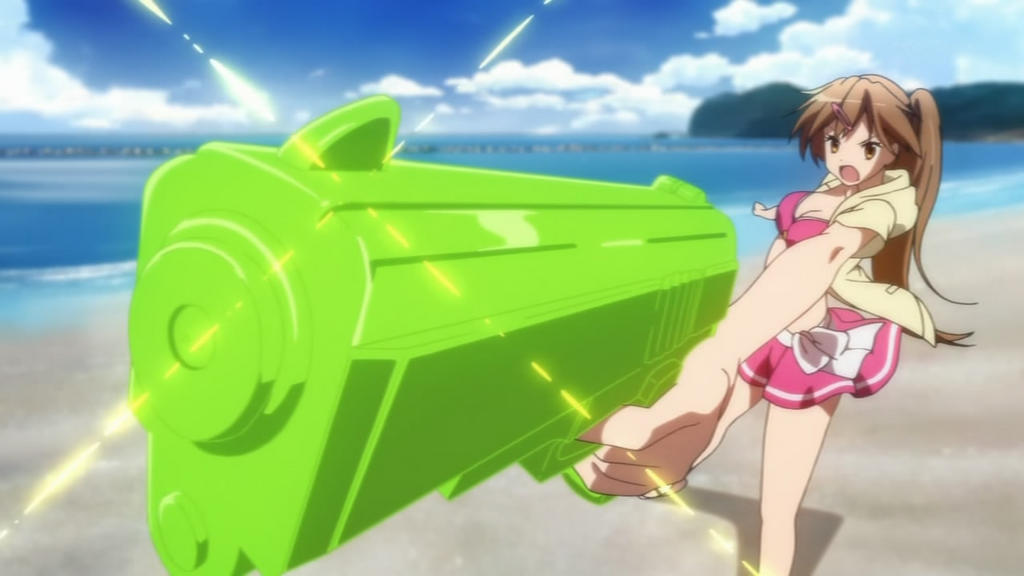
Next is (ultra-)wide perspective (aka wide angle perspective). This exaggerates near to far distances, making near objects much larger than normal (and far objects and people small). While ultra-wide is quite distinctive, moderately wide angle blurs into normal perspective since it involves only small exaggerations that can be hard to tell from what a normal perspective would be; what I think of as the usual sign of moderate wide angles is that the scene is focusing on some foreground object or person while things happen in the background (generally in reduced size). Strong wide angle emphasizes whatever element of the scene is closest to the anicamera; an extreme wide angle pretty much insures that this close object is the focus of attention.
(This shot from Chuunibyou demo Koi ga Shitai! (via) is a good example of a strong wide angle perspective.)
The final general perspective is telephoto perspective, which I don't think I've ever seen used in anime. While anime has long shots of things far away, telephoto perspective itself is the inverse of wide angle; it compresses the distance between near and far things, making them look close together and stacked on top of each other. This may sound rather abstract and unclear, so let's show you an example. This picture of mine is only moderately telephoto, but at least to me it doesn't look particularly far from the lamp post in the foreground to the elevated roadway and then to the building behind it. In real life, it's probably several hundred feet for each step (the elevated roadway is eight lanes wide here, for example).
(It's entirely possible that I've overlooked cases of telephoto perspective in anime, or maybe it's a sufficiently subtle effect in practice that I haven't noticed it when it was in front of me. I'd sort of be surprised if anime has genuinely never used the perspective, even if it was just a director playing around with it. I welcome pointers to examples, either in comments here or on Twitter.)
(Note that using a telephoto lens doesn't necessarily create a telephoto perspective; for example, you can have only a single clear thing in the picture, such as in this or this. Both were taken with the same lens and focal length as my telephoto perspective example.)
Sidebar: framing and perspective
To put it in simplistic terms, the difference between framing and perspective is that framing is what and how much you include in the picture while perspective is how the things in the picture look like in relation to each other. With physical cameras, framing and perspective are at least partially coupled together so the choice of one can put relatively narrow constraints on your options for the other (less so for cinematography than for still photography). Since anime is entirely drawn, you can frame a scene and give it whatever perspective you want to draw; however, some combinations of framing and perspective will look distorted, wrong, impossible, or absurd.
I talk about perspective here rather than framing partly because I feel that perspective has the stronger influence on the look of a scene. In anime especially, it's possible to frame a scene in the same way (or more or less the same way) despite significantly different perspectives. This is not to say that framing is unimportant to a scene's look, of course; it's just that it's less blatant than general perspective.
(The choice of perspectives is also more clearly analogous to lens selection with physical cameras than framing is.)