2016-12-25
Flying Witch shows me the limits of analysis
As an anime watcher, I typically seek out drama, by which I mean shows where something is happening and going on; often this means action of some sort, although not always. The further a show goes from drama the less likely I am to like it. I also tend to look favorably on shows that try to tell big stories with their drama, even if they don't entirely succeed (Concrete Revolutio is one example this year).
Flying Witch doesn't fall into this pattern. It has almost no drama as such (things happen but they're little self-contained things), and about the only thing that would normally attract me to it is the fantasy elements (which are a reliably way to get me to look at shows with otherwise ordinary settings). But I loved it in the spring season and it remains one of my favorite shows of the year. While not flawless, it was almost always fun to watch, it made me smile repeatedly, and it had a number of great moments of wonder and magic.
When I wrote my spring retrospective I attributed the show's success with me to 'execution', and when I was initially outlining this entry I was going to use Flying Witch as a springboard to praise shows that have modest goals but execute on them extremely well. But what does 'execution' really mean here? Can I actually put my finger on technical and story aspects that Flying Witch does so much better than average? The more I thought about it, the more I wound up feeling that when I said 'execution', what I really was doing was trying to find some reason that I liked the show so much when I didn't expect to. I couldn't find anything in specific, so I was attributing my liking to the intangible concept of 'execution' without being able to put my finger on anything concrete.
(This isn't to say that Flying Witch doesn't execute well; it very much does. It stages scenes very well, it looks beautiful, it has a great sense of place and of imagination, its comedic timing is spot on (as is its timing in general), and so on. But it does not have the kind of startlingly high quality execution that, say, Sound! Euphonium does. Regardless of what you feel about the story, Sound! Euphonium regularly knocks your socks off purely on a visual basis, and Flying Witch never did this in the same way.)
I'm someone who likes analysis on the whole, sometimes to excess. It helps me understand why a show works or doesn't work, and good analysis from other people can show me neat or important things that I hadn't realized (or hadn't consciously realized) when I was watching the show. But in thinking about Flying Witch here, I have come to really appreciate that analysis has its limits in trying to explain why I like a show.
Sometimes I just plain and simply like a show, and not only is that is all there is to it, that is all there needs to be to it. In the beginning and in the end, I'm here to enjoy the shows that I watch and a show that I enjoy is sufficient in itself; even to myself, I don't need to find reasons or justifications for my enjoyment. And I very much enjoyed watching Flying Witch, even if I can't tell you why in any coherent way.
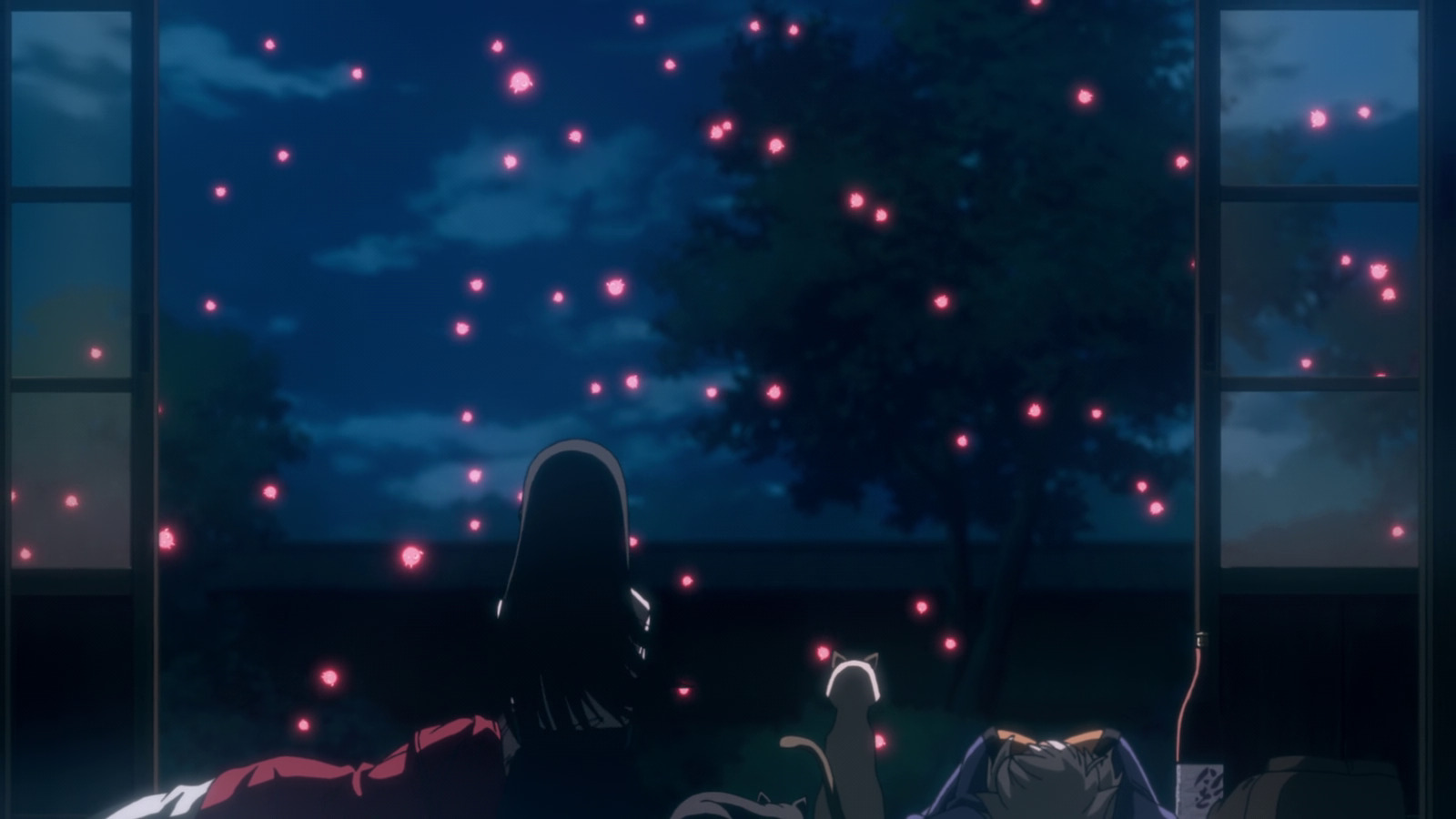
Merry Christmas, everyone.
(This is a 12-days post.)
2016-12-24
Thunderbolt Fantasy shows the power of fully embracing your genre
One of the best shows that I watched this year technically isn't anime. Thunderbolt Fantasy is a Taiwanese high-fantasy wuxia puppet show from a renowned Taiwanese puppet company; it slides into anime because it's co-produced by some Japanese anime companies, written by Gen Urobuchi, has a soundtrack by Hiroyuki Sawano, and so on. Basically it's anime not because of looks but because of one side of its lineage.
It would have been easy for Thunderbolt Fantasy to be pretty bad. Wuxia is awfully close to the kind of action fantasy that anime gives us in relative profusion (often from light novels), and those shows are only rarely even moderately good. Sure, Pili International was not going to do a bad job on the looks of the show (assuming that you can accept puppets and special effects in general), but just as important as the looks is the writing and Gen Urobuchi has written any number of stinkers to go with his solid work. And high wuxia is itself an inherently absurd and over the top genre, one that can easily fall into overblown camp.
But Thunderbolt Fantasy is good, in fact very good. Fundamentally it's good in large part because everyone involved fully embraced its genre. If they were going to do larger than life wuxia, they weren't going to be half-hearted about it; they were going to go big and dive in all the way. But fully embracing a genre isn't just about playing whole-heartedly into its cliches and its nature. It's also about not being lazy and about taking it seriously. There are absurdities that fit and absurdities that don't and things that are just lazy, and you must navigate through them all with care. Over all, you have to care and as part of that caring, you must work hard and do good work. Lazy writing, lazy planning, half-hearted gestures, taking the easy route, all of those will show through and send a show like Thunderbolt Fantasy plummeting in flames. Shows that are inherently absurd are balanced on a knife edge; they cannot forget that they're absurd but they must also commit to doing the absurdity with quality. That's what it means to embrace your genre.
(I won't go as far as to say that you have to love what you're doing, but I'm sure that it doesn't hurt. I'm pretty sure that all of the people involved in Thunderbolt Fantasy loved the whole idea, especially on the Japanese side.)
Gen Urobuchi did not take the easy way out when he wrote Thunderbolt Fantasy, and the results speak for themselves. Sure, there are crazy things but they are wuxia-crazy so they fit (such as the character who cuts his own head off so he can properly report his defeat to his necromancer boss), the overall plot is well thought out, and it has plenty of smart writing. The characters are all wuxia characters but they're well drawn and you can believe in them, a couple of them get character arcs, and the dialog often sparkles. There are genuine surprises, real laughs, and an actual understated romance that feels believable in a wuxia way.
(And there's also a spear-point, but just managing a spear-point doesn't necessarily make a work good by itself. All sorts of bad stories can manage one good moment where everything comes together for once.)
Of course Thunderbolt Fantasy is not the only show to achieve excellent results by embracing its genre whole-heartedly and truly understanding itself. This year many people praise Mayoiga (which I haven't watched as horror-ish stuff isn't my thing), and back in 2014 there was Witch Craft Works. Probably there have been others in genres that I don't pay as much attention to.
(Perhaps what Witch Craft Works did was slightly different, but I think of it as basically the same thing. Sometimes earnest is the wrong tone to take to make a work really shine, and sometimes it's exactly what you need. In both cases you can't be lazy and take the easy way out when putting the show together; you have to both care and commit whole-heartedly to what you're doing. Like Thunderbolt Fantasy, Witch Craft Works had smart writing with good characters and good dialog, and fully leaned into its nature with heart.)
PS: If you want to get an idea if Thunderbolt Fantasy is your kind of thing, you can do a lot worse than watching Thunderbolt Fantasy's OP. It's basically perfect for the show and is a great distillation of the whole experience. Certainly if you hate the OP and find it completely eye-rollingly absurd and over the top, you're unlikely to like Thunderbolt Fantasy itself.
(This is a 12-days post.)