2014-12-03
An example of telephoto perspective in anime, courtesy of Shirobako
Back in The perspectives of the anicamera I said that I didn't think I'd ever seen telephoto perspective used in anime. It turns out that I'm wrong about that, as a recent shot in Shirobako showed me. Let's start with the actual shot itself:
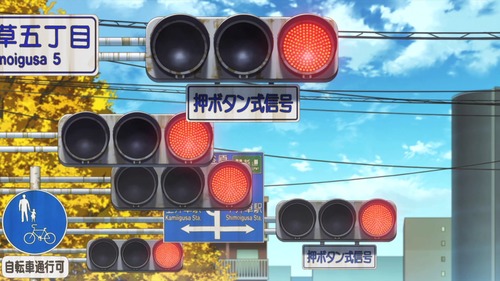
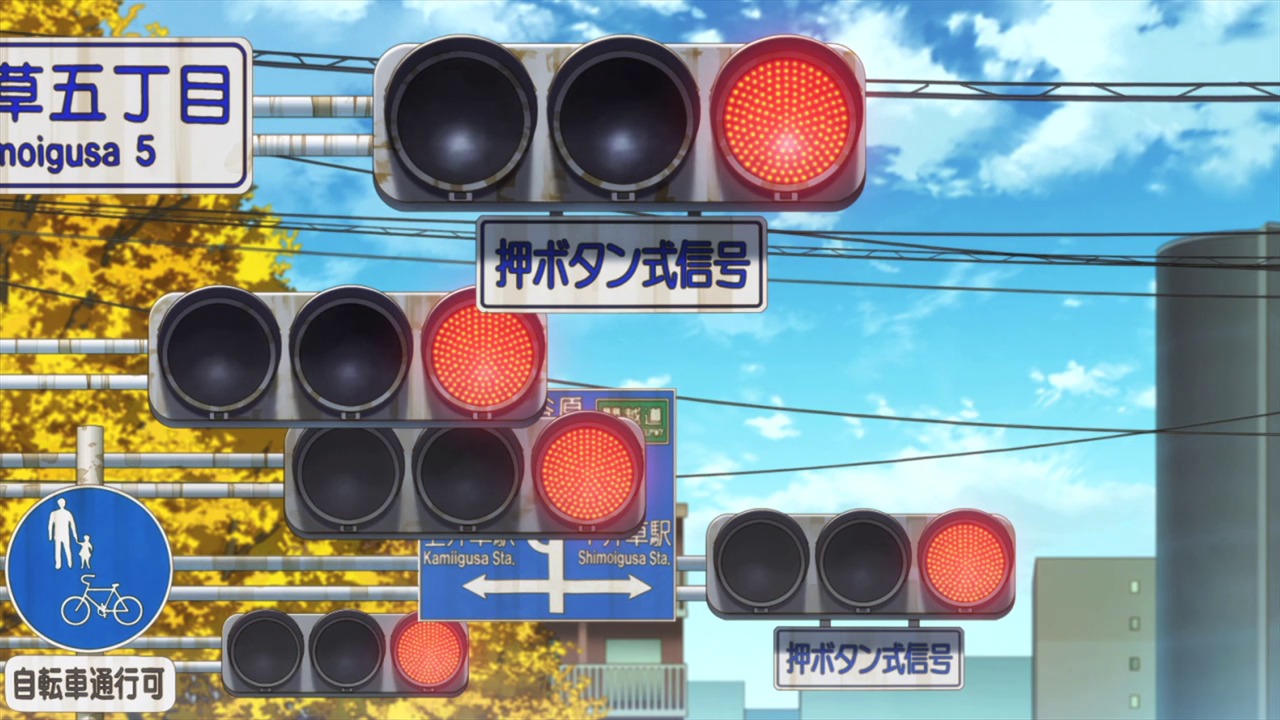
What we're seeing here is a classic telephoto perspective, where everything is stacked up on top of each other and there's very little distinction between close objects and further away ones. Notice, for instance, how little the size of the traffic lights changes at each step backwards into the scene, yet we're given the cue that they're not all at the same distance from us because they partially occlude each other. Even the features of the buildings in the background are relatively large and so look relatively close to us. This use of a stacked, dense perspective is deliberate and conscious on the part of the show. Nothing that the scene needs to show forces this view; in fact this shot is present almost entirely for its emotional effect (the only thing that matters for the flow of the scene is that we know the lights are red, to show why Miyamori stopped for a bit).
I suspect that this shot will feel familiar to you even if you haven't watched Shirobako. I'm pretty sure that this kind of compressed view into an urban distance cluttered with signs and wires and other parts of the city is actually not an uncommon shot and may even be common enough to be cliched. Certainly now that I've seen it here I'm sure I've also seen it before, undoubtedly going back a long way. It just didn't come to mind when I wrote the initial entry, partly because this effect is somewhat more subtle than a clearly exaggerated ultra wide angle view.
(I'm pretty sure that Neon Genesis Evangelion has similar shots and I'm sure that NGE didn't originate it. In a way it's such an obvious way of doing things if you want this effect on viewers.)
2014-12-02
Checking in on the Fall 2014 anime season sort of midway through
This is not exactly 'midway', but let's let that go; it's more than time for the usual midway check in on my early impressions of this season. I'm actually glad I waited this much because the latest episode of one particular show has caused a drastic change in my attitudes to it.
Excellent:
- Mushishi second season: In contrast to the first half of this
back in the spring, we're back to
powerful stories that fully engage me. Since Ginko has still
been a relatively oracular presence in a number of them, I think
that part of it is that the stories have moved away from being
horror stories and have become more about humanism and people
being very human.
- Shingeki no Bahamut - Genesis: This has flowered into a
full-throated, no holds barred adventure show. The characters
have settled down a little bit (in particular Amira has quieted
down, which makes me a bit sad) but they've kept developing in
interesting ways, while the story beats and the directing continue
to more than hit the mark. This show has verve and swashbuckling (and no
pretensions of being deep literature).
- Shirobako: After throwing jargon-laden situations at us in the first few episodes, the show has slowed down and found conflicts and problems that are intricately tied to the anime business but that don't require deep technical understanding to really get. In the process it's given us powerful episodes that are painfully real and without easy answers.
Things I'm still watching:
- Garo - The Animation: I want to love this as much as Bahamut
but with rare exceptions it simply doesn't have the verve of the
former show and the potential depths and sophistication it hinted
at in the beginning have yet to emerge. It doesn't help that it
had a run of decidedly conventional episodes before deciding to
finally do some interesting and powerful things.
(It doesn't help that it's too fond of setting its action scenes in very dim surroundings where, well, you can barely make out the action.)
- Hitsugi no Chaika - Avenging Battle: This remains Chaika. There
isn't much more I can say except that we're finally getting both
answers and character development, which is really what you'd hope
for at this point in the show.
(Sadly it is doing a few irritatingly cliched things. Really, a straight amnesia plot? Hasn't that been done to death by now?)
- Log Horizon second season: This has continued onwards in the
steady Log Horizon manner, putting one brick on top of the other
and building up over time to nicely done climaxes. The show has also
done a very good job of elaborating the world this season and doing
interesting things with it that simply feel right.
- Fate/Stay Night - Unlimited Blade Works: On the good side it has a budget and some nice fight scenes and Rin and Archer. On the negative side, it's Fate/Stay Night, Shirou and Saber and all. There isn't really anything more I can say than that. Well, there is one more good thing; I'm pretty certain that the writers and the show are fully aware that Shirou is kind of a prat. They certainly do kick him a fair bit and I don't think it's particularly designed to make us sympathize with him.
Flamed out spectacularly:
- Psycho-Pass 2: The show was limping along with both potentially
interesting things and eye-raising what the heck moments (including
a bunch of bad directing), which made it okay but not as nice as the
first season. Then episode 8 happened, with terrible writing and
directing and
much worse.
This episode was simply bad on all fronts and I don't expect it to get
any better.
(See also eg The Cart Driver's overall reaction to the show these days.)
Probably dropped:
- Ore, Twintail ni Narimasu: It's funny but apparently not funny enough because I don't feel any real interest in watching the latest episode. I'm probably going to listen to my gut and not force things.
Dropped:
- Madan no Ou to Vanadis: I lost interest for various reasons.
I will say that depicting battles through markers for the various
units moving around on a map is less 'showing' and more 'telling',
even if you pause periodically to show us bits of actual fights.
- Seven Deadly Sins: This wound up with too little fighting for
me. The 'that's enough' moment was when one episode ended on a
fight cliffhanger and the next episode ended the fight in about
thirty seconds flat.
- Amagi Brilliant Park: I didn't wind up watching any more after my early impressions and nothing I've heard about it since has pushed me to change that.
Apart from the unpleasant surprise of Psycho-Pass 2 and the surprising excellence of Shirobako, this is pretty much what I expected to happen. I'm maybe a bit disappointed in Chaika and Log Horizon, although that may be because of overly rose-tinted memories of their first seasons. Three excellent shows, three good ones, and a decent one is actually pretty good for a season, especially after summer.