2017-12-31
Some words on Flip Flappers ending and what I feel about it (and the show)
(There are spoilers here.)
Flip Flappers was always a show where the ending was going to matter a lot, and when the last episode aired I wound up somewhat uncertain about how I felt about it overall (and as a result, the show as a whole). This wound up being a big reason for the delay in my best N in 2016 entry, among other effects. In the spirit of the season, it's time to get some words down on this, starting with dry ones about the nature of Flip Flappers ending and how it's unusual.
I've written about how endings can be narratively or emotionally satisfying and also how they can be broad or narrow. In those terms, Flip Flappers' ending is clearly narrow, addressing relatively few of the outstanding issues (especially narrative ones), and it is also what I'll call oblique. By this I mean that the show only very rarely comes out to explicitly tell us things, confirm theories, or to say what emotional resolution characters have achieved. This obliqueness partly comes from being narrow, but it's also clearly a stylistic choice; all through its run Flip Flappers was very into 'show don't tell' and being subtle, letting us draw our own conclusions from what it showed us (often in passing). Narrow endings are uncommon and a fair number of people find them unsatisfying (especially people who want narratively satisfying endings).
(That Flip Flappers had a narrow ending is not surprising, because it was narratively narrow all through the show. While a great many things were going on in the show's world, the show itself generally followed only a few characters in essentially a third person limited perspective, especially Cocona, and it mostly focused on what mattered to understanding Cocona.)
As someone who cares more about emotionally satisfying endings, I'm basically fine with the narrative side of things in Flip Flappers' ending. Things like the story behind Asclepius and the Flip Flaps organization were ultimately unimportant to the story of Flip Flappers, which is Cocona's story (and sort of Papika's story too). There's one dropped bit that's hard for me to let go of because it influences how we see Papika and the people of Flip Flaps, and that's the question of whether the girl we briefly see sprawled out on the floor in Flip Flaps in the first episode is ultimately fine or if she was actually dead or damaged.
However, the narrowness and the obliqueness of Flip Flappers also limits the clear emotional answers that the show gives us in the ending. Does Yayaka get her fervent wish to reconcile with Cocona, for example? Well, almost certainly, since Cocona accepts her presence several times and Uexküll is happy to be with her at the very end, but Flip Flappers will not answer us explicitly. Many emotional developments with secondary characters are left at least partially open to our interpretation, for better or worse. This narrow obliqueness is a significant part of what gives me somewhat tangled feelings about the ending, because I'm not entirely sure what it's telling me, what I'm missing, and what I may be (incorrectly) reading into things I'm being shown.
(On the positive side, we are shown enough things and told about enough things so that we can make guesses. And if we're optimistic people, those will be optimistic guesses.)
But there are some things the ending gives us clear answers on, and one of them is Cocona's choice. Cocona started Flip Flappers as someone dutifully living an ordinary life and claiming to want it; in the final episode, she's given an opportunity to truly have that life and decisively rejects it, so much so that she spends her entire time there trying to find her way out. In the end, Cocona chooses joy, and specifically she chooses her joy of being with Papika. They rise together, flying with butterflies, and burst into the real world with exultant smiles and clasped hands. This ending is the heart of Flip Flappers, and as the heart it is purely joyous and thus basically a perfect emotional capstone.
In the most important way, the ending of Flip Flappers gave us an answer and completes a story. The details matter, but they are ultimately not essential and the show never implicitly promised us many of them anyway. I have wound up feeling that the ending says what it needs to say, it says just enough about some things to feel satisfying without falling into the trap of over-explaining things, and it says what it says very well (yes, including the fight with Mimi).
The show does not speak to me in the deep way that it does to some people, and it will probably never be something that I consider an all time masterwork (but ask me again in a few years and I may feel differently). To a certain extent, this entry and my entire tangled feelings about Flip Flappers is me coming to terms with that, that I don't love this quirky beautiful and very anime show quite as much as some people do and perhaps as much as I feel that I should.
(As a postscript, looking back on 2016 with the benefit of another six months of distance, I fully agree with my past self's selection of Flip Flappers as my best show of 2016.)
2017-12-25
Kemono Friends and the magic of anime
Sometimes, anime is magic. There are many forms of this magic, and we saw a number of them this year, as we usually do; there were touching stories, dramatic spectacles, quietly true to life works filled with little details, emotionally wrenching scenes, shows that are over the top in the best way, and quiet meditations on life delivered by blobby characters in deliberately scratchy backgrounds. But one of the ways that anime is periodically magic is that it can completely surprise us, with a show coming from left field to be excellent.
(Aroduc used to mention one example in his season previews as a cautionary note to not base too much on preview impressions.)
These surprises are one of the reasons that I keep watching anime. When they happen, they're magical; what once looked like dross is transmuted into unexpected gold. It's an unlooked for present that usually leaves me stunned and awed and glad that I was there to see it. And there's a joy in it beyond myself, because it means that the people who made the show have achieved something beautiful in their work and I have to imagine that that's a great feeling for them.
Kemono Friends did not exactly start out promising, seeing as it was a CG anime made on a shoestring, by a tiny team who'd done almost nothing, with the premise of a basic kid's show, based on a mobile game about animal girls that had failed before the show started. Early views were strikingly down, for example Bobduh's capsule summary of the first episode:
Kemono Friends is a simplistic show for very young children starring grotesque CG. We are still multiple categories from the bottom of this list.
(Like many other people, Bobduh would wind up changing his mind on the show.)
Then the show's astounding qualities began to show through, probably first in Japan and then later in the west as news and buzz spread. Despite everything we did think initially (and for good reason), improbably and absurdly Kemono Friends was really good. More than good, it was excellent. The janky CG ultimately didn't matter when set against its honest sincerity and heart and the skill of its creators that let it pull off story beats that few shows can manage and deliver thrilling drama. Yes, it was a kid's story, but it was the best sort of kid's story, one of the ones that have significant depths and moments of great emotional impact for everyone. One of the kid's stories that are magical.
(The best kid's stories understand that you cannot talk down to kids; kids are just as sophisticated consumers of stories as adults are, they just have different tastes. Good kid's stories are made with just as much care and good writing as good adult stories.)
This year, Kemono Friends embodied the magic of anime, the magic of delivering a complete, unasked-for, unpredictable surprise of a beautiful, thought provoking show that I'm glad that I was there to see and that has left an enduring impression on me. To quote Bobduh again:
I don’t know how Kemono Friends exists, but it feels to me like a perfect example of why we watch anime at all. Sometimes the best stories come in the most unlikely packages. Well done, Kemono Friends.
So here's to you, Kemono Friends, and everything and every moment you earned with your heart and hard work.
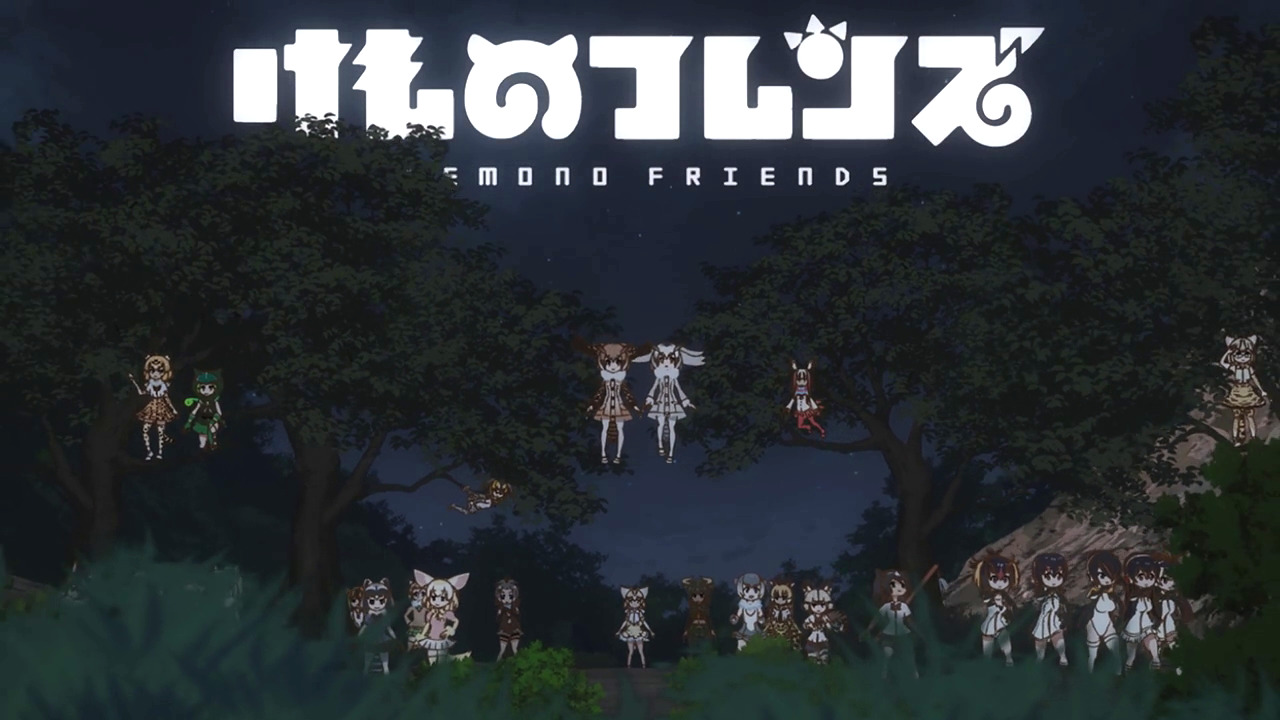
Merry Christmas everyone, and welcome to Japari Park.
(This is part of the 12 Days of Anime for 2017.)
2017-12-24
The importance of Kanna in Miss Kobayashi's Dragon Maid
(There are spoilers here, if you care.)
I'm not generally one for child characters. It's all too easy for a show to make them either grating or too sugar-sweet (and sometimes both at once), and if we're being honest most children are not infrequently brats. So when MaiDragon (to use its common abbreviation) introduced Kanna, I didn't initially think very much of her, especially since she was presented as sort of a joke. By the end of the show, my view had shifted and I now think that in many ways Kanna is the emotional lynchpin of the show, the point and character around which the central issues of the show revolve.
Kanna did not make Kobayashi and Tohru a couple, or even perhaps a family; they would have gotten there in the end even without her presence. But Kanna was the catalyst that crystallized the family into existence earlier than it might otherwise have formed and then made it obvious to us. Kanna was the force that pushed Kobayashi to make significant moves to recognize that family; the move to a larger apartment, the move to leave work earlier and to make time in her life for Tohru and Kanna (as exemplified especially in episode 9, the school sports festival episode). And in the final (TV) episode, it's my view that Kanna is a major force that pushes Kobayashi to recognize how much she misses Tohru. Without Kanna there to put burdens on Kobayashi that constantly remind her of Tohru's absence, I think Kobayashi might have quietly slid back into her pre-Tohru life; not because she really liked it, but just because it was the path of least resistance.
All of this leads to the emotional resolution of the series, where Kobayashi takes Kanna and Tohru to meet her parents. This is the point where Kobayashi implicitly takes into her heart that she's part of a family, even if it's an unusual one. The family may have formed quietly, but this is where it's officially acknowledged, even if no one says it out loud, and Kanna is at the heart of it.
Miss Kobayashi's Dragon Maid is one of two shows I watched this year that are clearly in large part about family (Alice & Zoroku is the other). It's about the accommodations you make to be in a family, and the changes that happen to you and others. More than its comedy, more than its amusing characters, more than its fun animation, this is why it's very likely to stick in my mind, and Kanna with it.
(This is part of the 12 Days of Anime for 2017.)