2018-12-25
An appreciation for Laid-Back Camp and Shima Rin
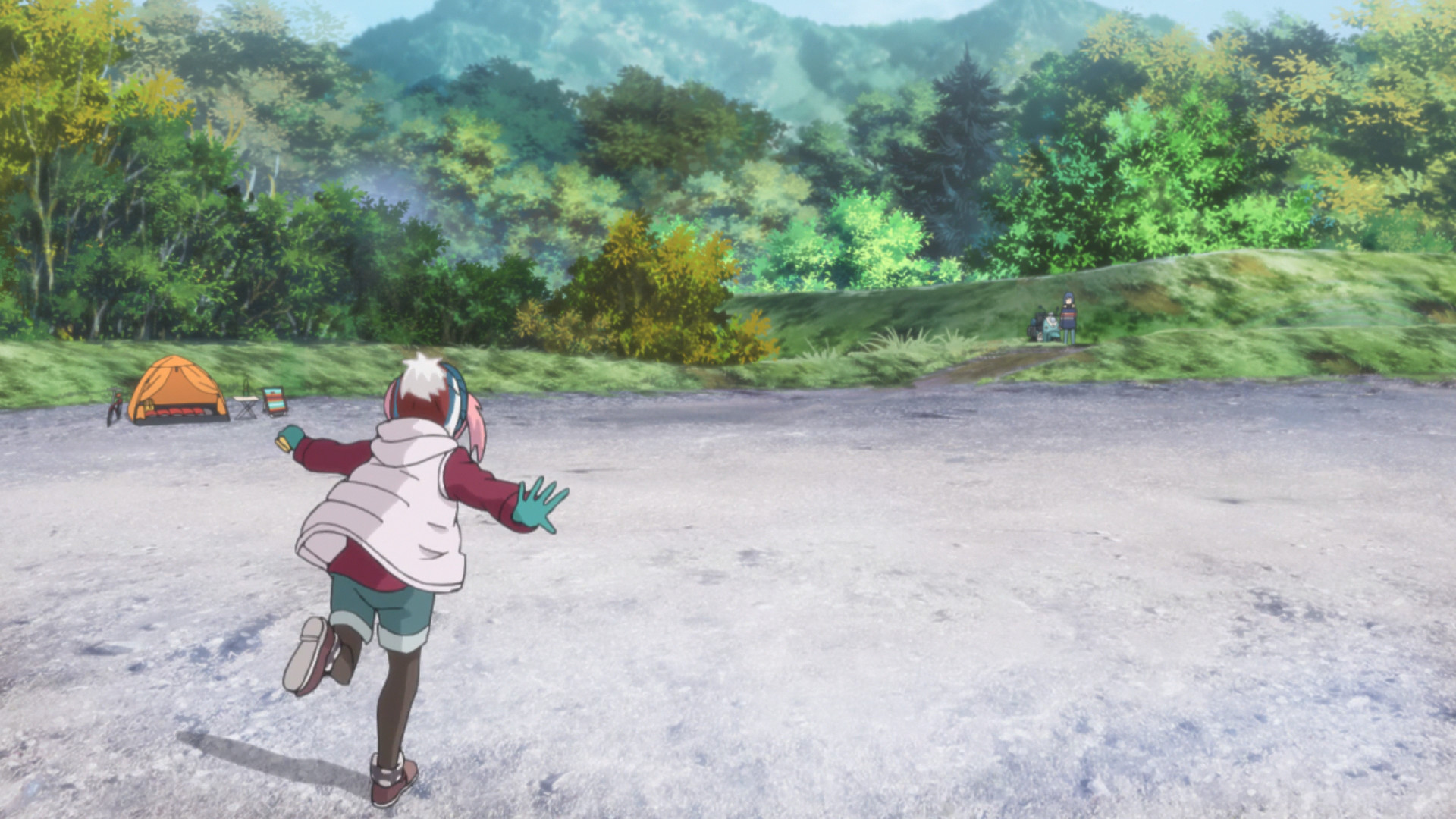
Looking back, I think that I fell for Laid-Back Camp right from the real start of the show, after the first episode's OP. The whole sequence of Shima Rin biking along (on a compact bike, loaded down with gear) through the autumn surroundings, then setting up camp and settling in, all amidst quiet beauty and just in general quiet was compelling for all sorts of reasons. I like seeing people set up things like this, and the show loved camping (complete with its little educational interludes) and the surroundings, and the whole thing was quiet and unhurried, but beyond all of that it just worked for me. Then the whole thing wakes up and makes me smile when Nadeshiko walks into the scene; it's a different feel entirely, but no less enjoyable.
I don't have a nice pat answer for why Laid-Back Camp is a show that I enjoy so much. Instead it is a show much like Flying Witch, where I simply like it without being able to completely articulate why. However, I can put my finger on some of what I find so appealing, because out of all of the characters and all of the activities in Laid-Back Camp, what I'm most drawn to are Shima Rin's outings, especially her solo ones. Like Shima Rin, I think of myself as a bookish loner, and I have enough experience of the outdoors to appreciate and enjoy her camping adventures (even if I have no desire to emulate them, especially in cold autumn weather). And the show is more than willing to let the surroundings speak for themselves on Rin's trips, lovingly dwelling on the outdoors and making the situation seem inviting despite the temperatures.
But Shima Rin is not precisely a loner. Even if she doesn't camp with other people very often, she's connected to them through her cellphone (as covered very well in @SpiritusNoxSA's great article) and through direct friendships and interactions. In many ways the heart of the show is this slow growing interaction, especially between Rin and Nadeshiko, who is herself a solid and appealing character.
The obvious heart of Laid-Back Camp is the simply gorgeous sequence in episode 5 where Rin and Nadeshiko text photos of their respective beautiful night-time views back and forth, comfortably separate and together at once. But for me, the bit I will remember most strongly is the epilogue at the end of episode 12, where Nadeshiko goes solo camping, exchanges texts with Rin (who is also solo camping), and then Rin reveals that she's at the same campsite. To me, it says so much about both Rin and Nadeshiko, and about how both of them they have both changed and not changed over the show (and also).
I may not know why I like Laid-Back Camp, but I do know that it lives in my heart, like a warm campfire at night. So here's to you, little show, with all your warmth and funny moments and great characterization and goofyness and quiet and beauty and contentment.
(The OST is pretty great, too. Laid-Back Camp's background music is an important part of its mood, and its mood is a big part of why it works so well.)
PS: It's not completely clear if Rin's and Nadeshiko's bikes are folding bikes or merely ones with small wheels and frames, as we never see them folded. But there's very little reason to make a non-folding compact bike, so I rather suspect that they are folding bikes.
PPS: Yes, that bikes feature in Laid-Back Camp is indeed one thing that initially attracted me to it. Sometimes I'm a sucker for bikes, although not for bike racing.
(This is part of the 12 Days of Anime 2018.)
2018-12-24
Rewatching Black Magic M-66
Black Magic M-66 is a fun little 1987 action OVA of an early 1980s short story manga by Masamune Shirow. Among other things, it is one of the few anime adaptations that is directed or co-directed by the manga author; Shirow is credited as co-director and for storyboards. The story itself is pretty straightforward, and is usually summarized as 'the efforts of a female journalist to save someone from an out of control military android'. As an early Shirow work and a short story, it's pretty much free of the ornamentation and twitches that show up in his later and longer works (you will not find much philosophical rambling here, for instance). With its limited run time and limited story scope, it's pretty much all action and setup for action, although it covers a surprising number of additional bits and pieces in the process.
Animation and production wise Black Magic M-66 is quite 1980s (with elements that feel distinctly old fashioned), but in a different way than Crusher Joe (which I watched last year); it's more Bubblegum Crisis than early 1980s. Part of this is that it's infused with Shirow's general design sense, which even then seems to have been pretty cyberpunk (in the military flavour). There are a certain amount of what are now amusing 1980s anachronisms, like the reporter's giant video camera and tape reels, and some of the outfits, and a cameo of a video telephone terminal (once a 'sure to come in the future' thing). But despite its 1980s origin, the whole thing stands up perfectly well today; it looks different, but not bad.
Black Magic M-66 may be straightforward, but it's also fun. The story (such as it is) is solid, the characters (such as they are) are amusing and good, there's periodic amusing bits, and both the action and the tension are well done. This is a race against time and against an opponent, and it works even when you have a reasonable guess of what's generally going to happen next. The M-66 is an implacable, persistent, and even clever opponent, but not an infallible one, and it has weaknesses. Also, the entire story is driven by a core mistake, where the M-66 was transported with test target data loaded that aimed it at a real person, and sadly this core mistake is all too realistic; over and over again us programmers use real data in testing and have it blow up in our face.
I first saw Black Magic M-66 a long time ago, and I rewatched it now for a tangle of reasons. Certainly part of it was that it was there and not very long (it's about 45 minutes), but also part of it was in reaction to not rewatching Full Metal Panic!. To some extent I wanted to rewatch something old that I had fond memories of and actively re-confirm those memories, so I could have more confidence in my past taste and my fond memories of past anime. Black Magic M-66 fits the bill nicely, and I think I liked it as much this time around as I did originally.
There's a number of things I noticed this time around that I either didn't spot or didn't remember from the first time. There's a military unit involved in the story and Black Magic M-66 is a lot less down on them than I would have expected; it's actually pretty sympathetic and also gives them some moments of humanity. The military and the reporter are effectively partners in saving the M-66's target, although each of them might object to that description. It's a little bit hokey that the military didn't use better weapons against the M-66, but the story does provide a couple of justifications and you can read between the lines to it being important to the powers that be to recover the M-66 in reasonably intact condition, never mind what it does to the people who have to achieve that.
(In fact, looking objectively at the story you could argue that the reporter's heroism is potentially unnecessary and the military would have done fine on its own, despite what she believes. I'm not quite sure this is true, because there are a couple of times where the reporter is there before the military is and saves the M-66's target, but it's at least close. This is an interesting angle for a story that is ostensibly about the reporter's heroism to take, although her heroism is genuine (and gets her respect from the military).)
I suspect that my current reactions to parts of the story are touched by this post 9/11 world we live in. Tall buildings more or less collapsing have a bit more bite than they probably did in 1987, as does a military unit running around ordering people in secrecy, shutting down news, and so on (although I suspect that this always read differently in Japan than in the West).
(There is also that Black Magic M-66 has 'flying cars' in the form of more or less planes that fly around at low level inside the city and have parking areas and so on. And yes, we have one getting shot down and crashing. This is very 1980s SF for anime from what I remember and shows up all over, but it reads quite differently today. In the 1980s it was futuristic and imaginable. Today, not so much.)
In my personal rating of Shirow animated works, Black Magic M-66 probably ranks highest of all anime that is directly based on a Shirow story instead of simply drawing from it. The Ghost in the Shell: Stand Alone Complex TV series is significantly better and deeper, but it draws from Shirow's GitS manga instead of trying to animate it. The GitS movie, well, I have complicated feelings about that one and don't rate it very highly.
This sort of elaborates on some tweets of mine, because I feel like it.
PS: There are any number of things I find neat about Black Magic M-66 that I'm not mentioning here, because this is already long enough. There are all sorts of little details about it that I enjoy.
PPS: This time around I discovered that the M actually stands for something; specifically, it's 'Mario'. Really. It's even in the title card. I really don't have anything I can say here, except that I'm going to try to forget it again.
(This is part of the 12 Days of Anime 2018.)