2016-12-28
A bit on the story structure of Sound! Euphonium 2 episode 12
(There are spoilers here.)
In commentary about Sound! Euphonium 2's episode 12, a number of people have noted that KyoAni took the unusual step (for the show) of not showing Kitauji High School's performance at the Nationals. Instead of seeing any of their performance, we cut straight from going on stage just before the commercial break to the after performance wind-down after the commercial break. Nick Creamer's episode writeup at ANN is typical, and he says:
And then it was over. Sound! Euphonium's final performance, the nationals performance that this whole season had been leading up to, took place entirely during the episode's commercial break. I had to laugh at that - after all of this work, after performance sequences as stunning as last season's conclusion and this season's halfway point, it felt like an intentional flaunting of expectations to actually cut this one out.
In my opinion there's a very good reason that KyoAni did not include the performance and it has nothing to do with flaunting our expectations and everything to do with story structure (and a bit to do with how stunning those past performances have been). You see, this time around Kitauji lost. And not because anyone screwed anything up, as far as we're told; everyone played their best, it's just that at the level of the Nationals, their best was only bronze level.
In the two previous performances that Sound! Euphonium showed, Kitauji won; they took gold and moved onward towards the Nationals. Portraying this in a show is theoretically simple, as all you need to do is show everyone playing well. We the audience will read into the combination of a dynamic, well-done performance that sounds good and Kitauji taking the gold the implication that Kitauji had the best performance, without the show actually having to show this explicitly by, saying showing another, not as good performance by another high school.
All of this goes out of the window when Kitauji's performance is only good enough for a bronze. How do you portray a performance that is good but only so good, especially when you've shown Kitauji playing very well before? If you just show Kitauji's performance (and at their previous level), the audience is unlikely to be convinced that they only deserved bronze. So to really sell this you would probably have to show at least parts from both Kitauji's performance and a clearly better performance (ideally one that only got silver). That is a tall order both simply for time in the episode and also for showing relative performance level, especially when Kitauji is supposed to be good to start with.
(The one time Sound! Euphonium did a compare and contrast performance it had the significant advantage that one of the people involved was clearly not all that great at her solo. Portraying 'good, without errors' and then 'clearly better' for orchestral music is likely to be hard, especially if you want it to be unmistakable to the audience.)
Given all this I'm unsurprised that KyoAni skipped completely over the actual performance. There just wasn't any good way to portray it, at least not without a lot of work and risk of audience (dis)belief in the outcome. Skipping it was almost forced by the structure of the story. As much as we might have liked to see it, it would have been hard for the show to not let us down if we actually got the performance.
(And this way the show could preserve tension that held through to the revelation of the results. If the show had convincingly told us that Kitauji's performance was below the level of other bands at the Nationals, we'd have known they weren't getting gold well before the results were announced.)
(This elaborates on some tweets of mine, because I felt compelled to make my logic explicit.)
PS: To be clear, I don't fault KyoAni for this decision or think that it weakens the episode. On the contrary, I think it's a clever solution for a real problem, one that has significant advantages and helps the overall story of the episode.
2016-12-25
Where I think Flip Flappers' episode 9 Pure Illusion world comes from
This goes with my views on the Pure Illusion worlds of the first eight episodes. Pulled over from Twitter:
@cks_anime: Pure Illusion in Flip Flappers episode 9 isn't obviously based on anything (to me), but my theory is that we're seeing inside Yayaka's head.
It's certainly striking to me how the Pure Illusion world has a bunch of visual similarities to the locker room [that Yayaka is in] at the start of the episode.[...]
@cks_anime: Also: Yayaka's desires clearly altered the world towards the end, which I don't think she's done any other time.
(It's not clear if she consciously willed things to happen or if the world just knew what she wanted & did it.)
While not all Pure Illusions worlds are tied into the cast, I think that the world from episode 9 is too on-point with what's going on with Yayaka and too visually similar to the real world scene we see her in at the start of the episode to not be related to her (and the world is the way it is even before she arrives in it).
I can also read the world responding to Yayaka's desires as similar to the Pure Illusion world in episode 1 responding to Cocona's feelings at the end of the episode. And it's now pretty clear that the episode 1 world really is Cocona herself.
(This all feels relatively obvious but I wanted to get it down anyways, and not just on Twitter.)
Flying Witch shows me the limits of analysis
As an anime watcher, I typically seek out drama, by which I mean shows where something is happening and going on; often this means action of some sort, although not always. The further a show goes from drama the less likely I am to like it. I also tend to look favorably on shows that try to tell big stories with their drama, even if they don't entirely succeed (Concrete Revolutio is one example this year).
Flying Witch doesn't fall into this pattern. It has almost no drama as such (things happen but they're little self-contained things), and about the only thing that would normally attract me to it is the fantasy elements (which are a reliably way to get me to look at shows with otherwise ordinary settings). But I loved it in the spring season and it remains one of my favorite shows of the year. While not flawless, it was almost always fun to watch, it made me smile repeatedly, and it had a number of great moments of wonder and magic.
When I wrote my spring retrospective I attributed the show's success with me to 'execution', and when I was initially outlining this entry I was going to use Flying Witch as a springboard to praise shows that have modest goals but execute on them extremely well. But what does 'execution' really mean here? Can I actually put my finger on technical and story aspects that Flying Witch does so much better than average? The more I thought about it, the more I wound up feeling that when I said 'execution', what I really was doing was trying to find some reason that I liked the show so much when I didn't expect to. I couldn't find anything in specific, so I was attributing my liking to the intangible concept of 'execution' without being able to put my finger on anything concrete.
(This isn't to say that Flying Witch doesn't execute well; it very much does. It stages scenes very well, it looks beautiful, it has a great sense of place and of imagination, its comedic timing is spot on (as is its timing in general), and so on. But it does not have the kind of startlingly high quality execution that, say, Sound! Euphonium does. Regardless of what you feel about the story, Sound! Euphonium regularly knocks your socks off purely on a visual basis, and Flying Witch never did this in the same way.)
I'm someone who likes analysis on the whole, sometimes to excess. It helps me understand why a show works or doesn't work, and good analysis from other people can show me neat or important things that I hadn't realized (or hadn't consciously realized) when I was watching the show. But in thinking about Flying Witch here, I have come to really appreciate that analysis has its limits in trying to explain why I like a show.
Sometimes I just plain and simply like a show, and not only is that is all there is to it, that is all there needs to be to it. In the beginning and in the end, I'm here to enjoy the shows that I watch and a show that I enjoy is sufficient in itself; even to myself, I don't need to find reasons or justifications for my enjoyment. And I very much enjoyed watching Flying Witch, even if I can't tell you why in any coherent way.
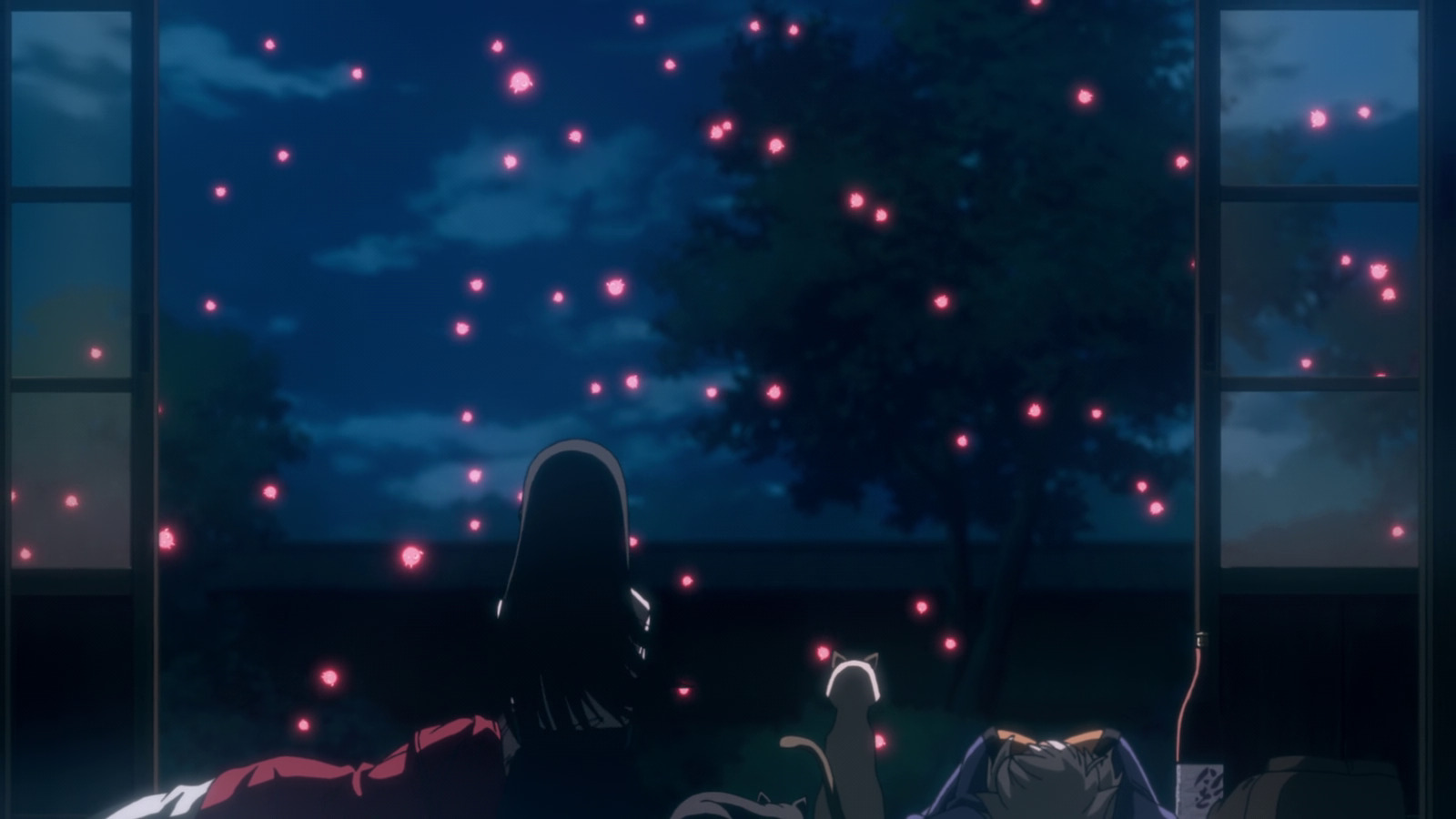
Merry Christmas, everyone.
(This is a 12-days post.)